
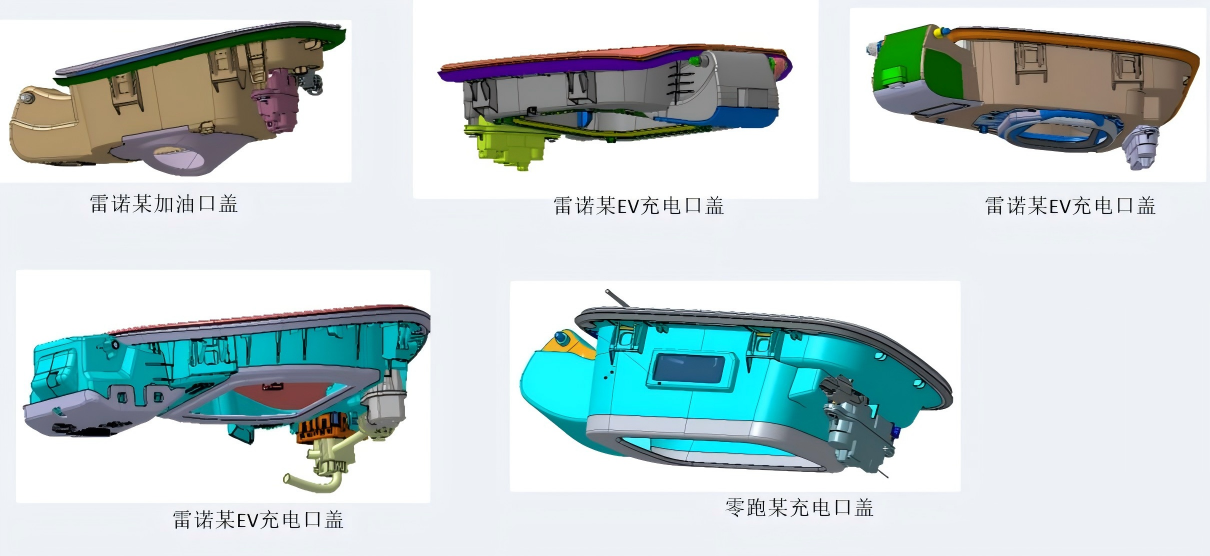
Charging Flap & Fuel Filler System Integration
Charging port and fuel filler assembly development for a traditional automaker’s hybrid platform
We were responsible for the exterior charging-flap and fuel-filler assembly structural design for a traditional automaker’s hybrid model. The project resolved the complex side-body openings and compact dual-port layout challenges of the hybrid platform, delivering the full process from digital modeling to tooling mass production, ensuring excellent waterproof sealing performance and operating feel.
--- Project Highlights ---
1. Dual-port integration & layout optimization: Addressing the limited side-body space of the hybrid model, we optimized the relative position of the charging flap (slow/fast charge) and fuel filler and the internal bracket structure, maximizing body interior space while keeping exterior DTS (gap/flushness) uniform.
2. Sealing & waterproof design: Leading the flap sealing system design, through multiple simulation analyses and real-vehicle water-spray tests, we optimized the seal compression and lip structure, effectively resolving leak risks caused by cumulative body tolerances and meeting IPXK waterproof requirements.
3. Opening mechanism & feel tuning: Responsible for selecting and arranging the press-to-release mechanism (or motorized open actuator), optimizing spring stiffness and damping to ensure consistent opening force across temperature ranges, improving operating quality and reliability.
4. Lightweighting & cost control: While ensuring structural strength, material selection optimization (e.g., plastic-replacing-steel) and weight-reduction design effectively controlled per-part cost, supporting the vehicle lightweighting goal.
--- Project Highlights ---
1. Dual-port integration & layout optimization: Addressing the limited side-body space of the hybrid model, we optimized the relative position of the charging flap (slow/fast charge) and fuel filler and the internal bracket structure, maximizing body interior space while keeping exterior DTS (gap/flushness) uniform.
2. Sealing & waterproof design: Leading the flap sealing system design, through multiple simulation analyses and real-vehicle water-spray tests, we optimized the seal compression and lip structure, effectively resolving leak risks caused by cumulative body tolerances and meeting IPXK waterproof requirements.
3. Opening mechanism & feel tuning: Responsible for selecting and arranging the press-to-release mechanism (or motorized open actuator), optimizing spring stiffness and damping to ensure consistent opening force across temperature ranges, improving operating quality and reliability.
4. Lightweighting & cost control: While ensuring structural strength, material selection optimization (e.g., plastic-replacing-steel) and weight-reduction design effectively controlled per-part cost, supporting the vehicle lightweighting goal.